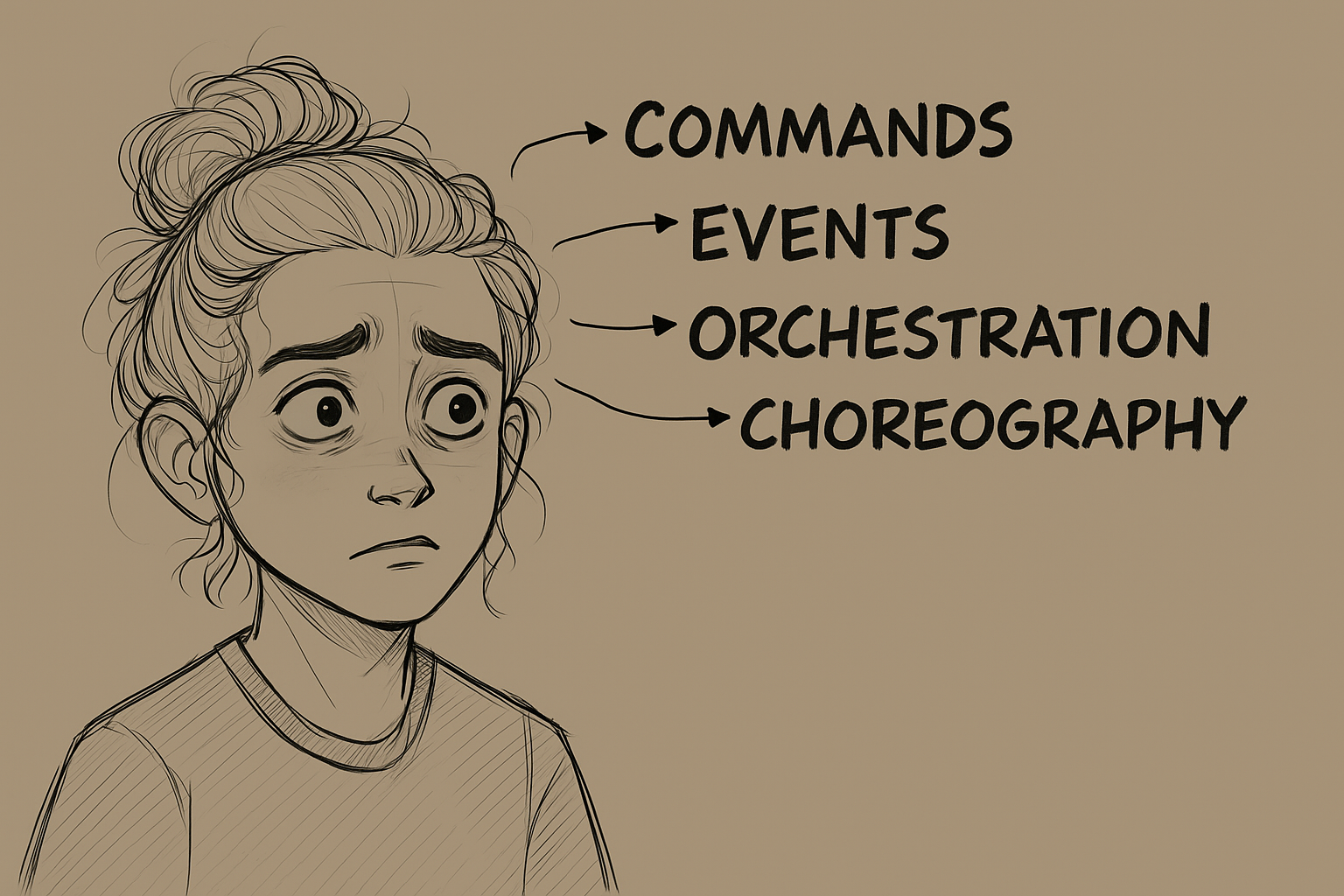
Designing distributed systems has never been more challenging. As teams embrace microservices and event‑driven architectures, a persistent myth has arisen: commands equal orchestration, and events equal choreography. This tidy equivalence often becomes a mental shortcut but conceals the deeper truth of control‑flow patterns versus messaging semantics. As many practitioners have observed, collapsing these separate dimensions can restrict your system's flexibility and resilience.
In this article, we'll demystify these concepts and show how to apply them independently. You'll discover how separating semantics (commands vs. events) from control flow (orchestration vs. choreography) grants you greater architectural freedom and clearer, more maintainable workflows.
Getting event names right in event-driven architecture and Domain-Driven Design (DDD) is essential for clarity, consistency, and scalability. A key decision is using singular or plural terms in event names.
Here's how I approach it, with examples and reasoning to help you make the best choice.
31 Jan 2025
Designing a payment system is like any other software solution I've worked on.
At first, it appears straightforward, but real-world factors like currency conversions, fees, payee validations and external APIs quickly add complexity.
Read More →
Defining clear boundaries is essential to building clean, scalable, and reliable architectures.
In my experience, organisational demands often override the focus on boundaries and domain-driven design. This reflects the tension between following technical best practices and delivering business outcomes quickly. While theoretical approaches are widely discussed at conferences, in books, and in videos, the practical implementation of these ideas is often shaped by cultural dynamics, resource constraints, tight deadlines, and internal politics.
In this post, we'll explore the challenges of maintaining boundaries and potential solutions, using a payment system as an example. This system facilitates transactions between clients and payment providers, such as PayPal or Stripe, highlighting the distribution of responsibilities within its architecture.