For most of us, AI still feels like a black box. We send it a prompt and we get back a blob of text. Maybe we write some code to call a tool; maybe we juggle a few callbacks. We tell ourselves that this is just how things work: a model can only generate tokens, and tools can only run in our code.
But what if this mental model is the problem?
In this post I want to argue that the Agent pattern in the AI SDK is as revolutionary for AI development as useState and useEffect were for React. Just like React's client/server directives annotate where code runs across the network, the Agent API annotates where logic runs across the AI/model boundary.
When building AI agents, where do your prompts live? If they're hidden inside frameworks or scattered across configuration files, you're missing a fundamental principle of maintainable AI systems: treating prompts as first-class code citizens.
After building production AI systems over the past few years, thanks to HumanLayer, I’ve learned that most agent failures aren’t about the LLM, they’re about architecture.
That’s why I’m creating a series of posts sharing the 12-Factor Agents methodology using Mastra.
In each part, I’ll break down one principle that transforms fragile prototypes into robust, production-ready AI agents.
Unlock reliable, testable AI agents by treating your LLM as a parser, not an executor. Learn how converting natural language into structured tool calls leads to predictable, scalable systems.
AI applications are shifting from monolithic large language models to modular, multi-agent systems—a transformation that enhances performance, flexibility, and maintainability.
In my talk about AI Agents last September, I said AI agents would become increasingly popular. Today, we see this shift happening across industries. By breaking down complex tasks into specialised components, engineers can design smarter, more scalable AI workflows.
Analogy: Think of multi-agent systems like a well-coordinated orchestra. Each musician (agent) has a specific role, and together, they create a harmonious performance. In software, this means dividing complex problems into manageable, specialised parts that work in concert.
In this guide, we'll explore four key multi-agent patterns, using travel booking as an example. You'll learn how to choose the right pattern for your application, implementation strategies, and error-handling techniques to build robust multi-agent AI systems.
Agentic systems, where multiple AI agents collaborate through decision-making and handoffs, shine in specific scenarios but add operational complexity.
In this post, we'll explore the scenarios where agentic systems are most effective and the challenges you may face when using them.
The goal of creating something "predictable," reliable, and consistent is a shared principle across all the teams I've worked with throughout my career.
Knowing that the same code would always return the same output when given the same inputs was the foundation of everything we built.
We aimed for no surprises, no matter how complex a workflow might be.
Whether implicitly or explicitly using finite state machines, this determinism enabled us to build testable, monitorable, maintainable, and, most importantly, predictable workflows.
We read and shared ideas at conferences, promoting patterns and principles like SOLID and DRY to create functional, composable, and extensible software.
Having lived through the era of a "new JavaScript framework every week," we now find ourselves in the gold rush of the AI agent framework space.
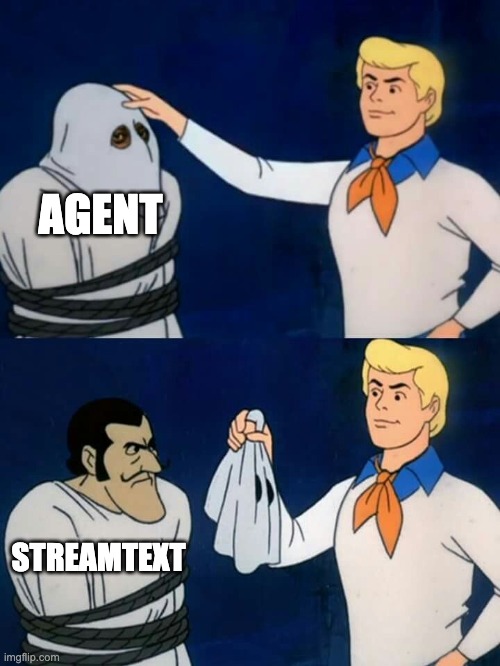
New frameworks appear daily, each claiming to be the 'ultimate' solution for building AI agents, often backed by YouTubers enthusiastically promoting demoware and usually their own library, framework, or SaaS offering. Unfortunately, this enthusiasm can lead companies to uncritically adopt these tools without considering the long-term implications.