Domain-Driven Design comes with a lot of vocabulary: aggregates, repositories, domain services, bounded contexts, ubiquitous language, anemic models.
That vocabulary can make DDD sound heavier than it really is.
The useful idea is simpler: keep domain behavior and domain boundaries central, and keep infrastructure, persistence, and framework wiring secondary.
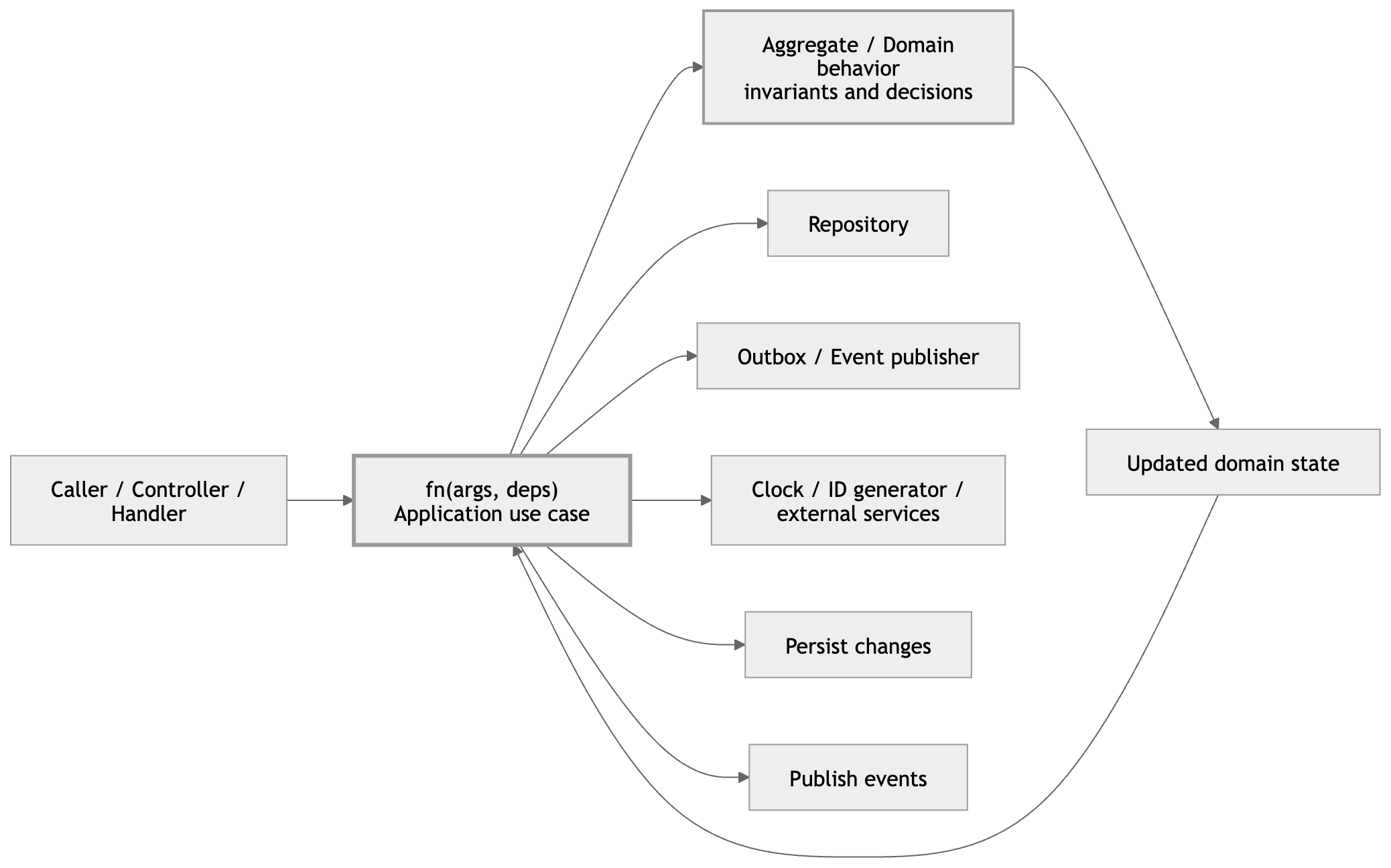
fn(args, deps) does not do that modeling for you. What it gives you is a clear shape for application-layer code in TypeScript: one place for use-case input, one place for collaborators, and less room for domain decisions to drift into wiring.
A lot of developers learn the SOLID principles through class-heavy examples.
That is probably why the conversation so often gets stuck there.
People start to associate SOLID with inheritance hierarchies, interface forests, service classes, and object-oriented ceremony.
But the useful part is not the ceremony.
It is the design pressure.
One of the simplest ways to apply that pressure in plain TypeScript is this shape:
fn(args, deps)
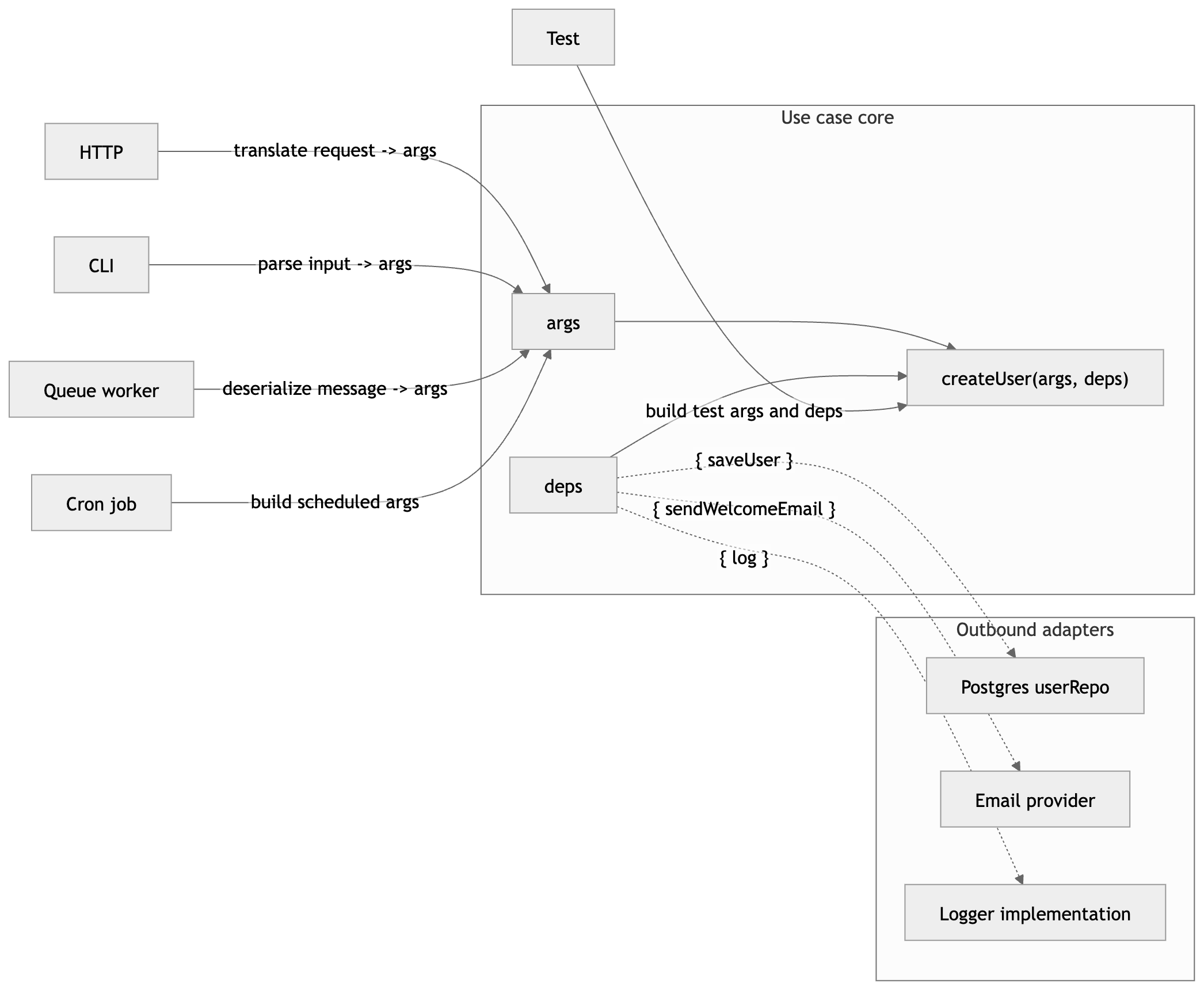
Where args is the input for this call and deps is the set of collaborators the function needs.
You can read that as: data in, capabilities in.
fn(args, deps) is not a replacement for SOLID. It is a simple function shape that makes several SOLID ideas easier to apply without forcing you into class-heavy design.
Many software systems fail for one very boring reason.
Not because of microservices. Not because of monoliths. Not because of whatever methodology war is trending this week.
They fail because they are unpredictable.
If you make a change and you cannot reliably determine the impact, you cannot safely evolve the system. And when you cannot evolve it, it starts behaving like legacy.
Determinism is the bridge between "works on my machine" and "works every time, everywhere."
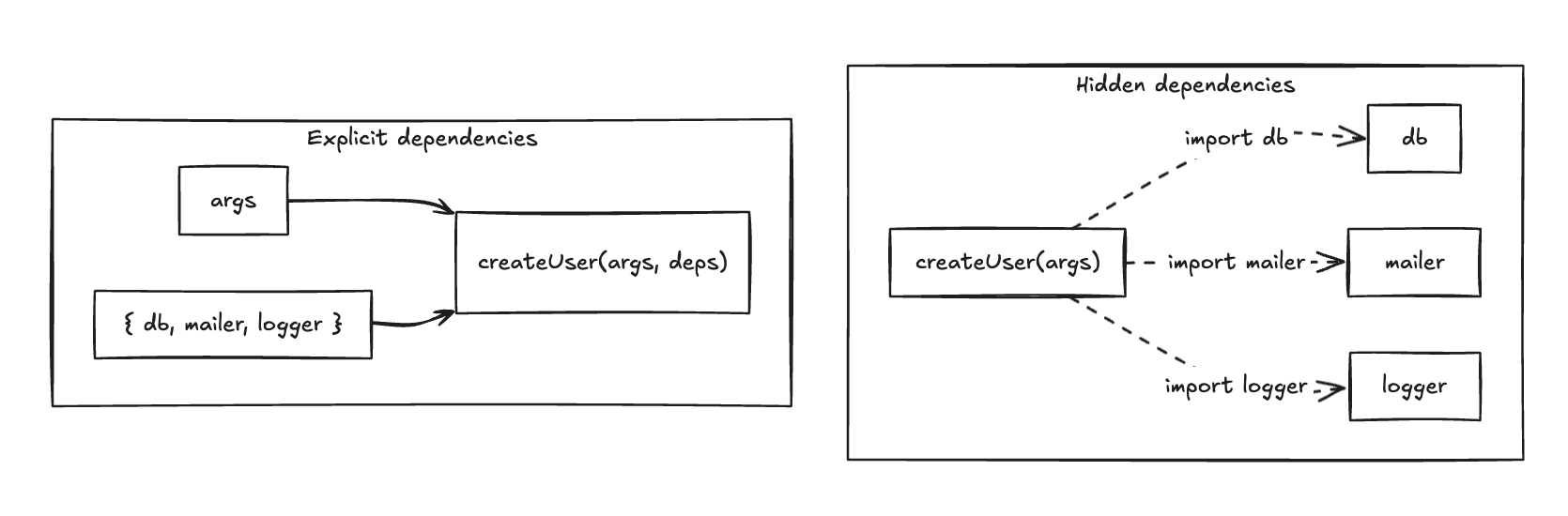
fn(args, deps) gets you there — not because it is a clever trick, but because it makes boundaries explicit. Your logic programs to interfaces, which is what lets you control sources of nondeterminism.
Just because two pieces of code look the same does not mean they are the same.
The most common architecture mistake is not too little abstraction. It is too much, too early. You see duplication, you extract a shared module, and six months later that module is a monster held together by special cases and boolean flags.
Dan Abramov gave a talk about this called The Wet Codebase. The core argument: the wrong abstraction is far more expensive than duplication. Once an abstraction exists, it creates inertia. Nobody wants to be the person who suggests copy-paste.
fn(args, deps) changes this calculus. It makes abstractions cheap to create, cheap to test, and cheap to undo.
When a function's deps grow too large, that can be a signal that some responsibility has stabilized into its own function — and that new function itself follows fn(args, deps). (This is basically SRP pressure showing up in your signature; see the SOLID post for that framing.)
Russian dolls. Each layer independently testable. Each layer reversible.
A lot of developers hear "dependency injection" and immediately think of containers, decorators, registration APIs, lifecycle scopes, and framework magic.
That reaction is understandable.
But that association often leads people to overcomplicate a problem that has a much simpler starting point.
At its core, dependency injection just means this:
Pass collaborators in explicitly instead of reaching for them implicitly.
One of the simplest ways to do that in plain TypeScript is this shape (introduced in the series starting point: fn(args, deps)):
fn(args, deps)
Where args is call-specific input and deps is the set of collaborators the function needs.
You can read that as: data in, capabilities in.
fn(args, deps) is flexible enough to support composition, testing, and clean application wiring without forcing you into a DI framework.
Getting event names right in event-driven architecture and Domain-Driven Design (DDD) is essential for clarity, consistency, and scalability. A key decision is using singular or plural terms in event names.
Here's how I approach it, with examples and reasoning to help you make the best choice.
31 Jan 2025
Designing a payment system is like any other software solution I've worked on.
At first, it appears straightforward, but real-world factors like currency conversions, fees, payee validations and external APIs quickly add complexity.
Read More →
Defining clear boundaries is essential to building clean, scalable, and reliable architectures.
In my experience, organisational demands often override the focus on boundaries and domain-driven design. This reflects the tension between following technical best practices and delivering business outcomes quickly. While theoretical approaches are widely discussed at conferences, in books, and in videos, the practical implementation of these ideas is often shaped by cultural dynamics, resource constraints, tight deadlines, and internal politics.
In this post, we'll explore the challenges of maintaining boundaries and potential solutions, using a payment system as an example. This system facilitates transactions between clients and payment providers, such as PayPal or Stripe, highlighting the distribution of responsibilities within its architecture.
As I stood in the rain as a volunteer race marshal at my local park run, it occurred to me that I wanted the same thing when running applications in production, and that's absolutely nothing to happen.
The last thing I wanted to do was be a hero.
🎸 "Always keep on the right side of the path" – the Parkrun version of Monty Python's song.
I'd rather everyone enjoy a safe, smooth race where I can cheer and encourage people on as they pass, reminding them to keep to the right so they don't collide with runners coming the other way.
It's the same in the land of IT. The only thing I want to see when viewing Grafana dashboards is a sea of green, 200 status codes and steady traffic patterns.
Saturday's Oasis ticket sales left thousands of fans disheartened after spending hours in virtual queues. As reported by the BBC and echoed by fans on X (formerly Twitter) and Reddit, the experience could be aptly described using a quote from Liam Gallagher himself:
Like many others, I have long been frustrated with platforms like Ticketmaster, See Tickets, and Gigs and Tours. This weekend, their reputations took another hit as fans faced inflated prices and technical glitches.
This made me think if I could design a better, more reliable ticketing system that prioritises fairness and user experience.
Let's not make Sally wait any longer than she has to.