There’s a major disconnect in AI-assisted development right now. Most of the conversation assumes you’re building something new, or working from the kind of clean, stable foundation that barely exists in real engineering teams.
The reality is that most engineering teams live in legacy systems under high load, with god classes, global singletons, and console.log as observability. The kind of code where every change is a gamble.
This post shows what happens when you apply fn(args, deps) and autotel to those codebases. fn(args, deps) creates the seam for safe change; production telemetry captures the behavioural record that survives when every other spec has decayed.
To prove the point, we’ll do this in plain JavaScript, not TypeScript.
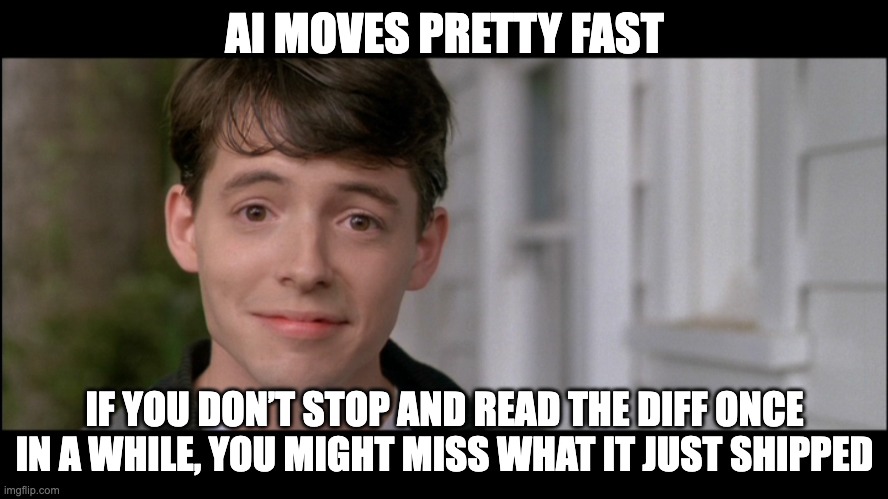
AI coding agents produce code faster than you can review and understand it.
One pattern works in both new and legacy codebases because you can adopt it incrementally, without breaking callers.
For business logic, treat every function as having two inputs: data (args) and capabilities (deps).
Without a clear constraint, generated code becomes harder to reason about: dependencies disappear, side effects spread, composition gets messy. This is why visible structure is essential.
Message isolation using a shared queue: propagate tenant ID in Kafka message headers; consumers use tenant ID for selective message consumption.
They make the case that infrastructure duplication is expensive. Instead of separate Kafka clusters per environment, use tenant ID filtering on a shared queue. Instrument producers and consumers for context propagation.
We've all been there: maintaining four "identical" Kafka setups that slowly drift apart.
Their key insight:
Requires modifying consumers and using OpenTelemetry for context propagation.
Request-level isolation is the most cost-effective approach.
They make the case against duplicating infrastructure for testing. Instead of spinning up separate Kafka clusters per tenant, use OpenTelemetry Baggage to propagate tenant ID through async flows. Consumers filter by tenant ID. Istio handles routing.
We've all been there: every team has their own "staging Kafka" and costs balloon.
Their key insight:
Use OpenTelemetry Baggage to propagate tenant ID through sync and async. When publishing to Kafka, producers inject trace context (including baggage) into message headers; consumers extract and make routing decisions.
As engineers, one of our primary responsibilities is to ensure that the systems we build are stable and reliable.
However, despite our best efforts, issues and issues will inevitably arise in production environments. When this happens, it can be tempting to try and patch the problem and move on quickly.
However, recreating production issues locally is a critical step in the debugging and resolution process.
In this post, I'll explain the benefits of reproducing production issues locally.